Zebra Finch

The Zebra Finch, is the most common and familiar estrildid finch of Central Australia and ranges over most of the continent, avoiding only the cool moist south and the tropical far north. It also can be found natively in Indonesia and Timor-Leste. The bird has been introduced to Puerto Rico , Portugal ,Brazil , and the U.S..

The ground-dwelling Zebra Finch grows to a size of about 10 centimetres (3.9 in) long and prefers to eat grass seeds. This species' vocalizations consist mostly of chattering trills and calls.

Habitat

Zebra Finches inhabit a wide range of grasslands and forests, usually close to water. They are typically found in open steppes with scattered bushes and trees, but have adapted to human disturbances, taking advantage of human-made watering holes and large patches of deforested land. Zebra Finches — including many human-bred variants to the species — are widely kept by genetic researchers, breeding hobbyists and pet owners.

The Zebra Finch breeds after substantial rains in its native habitat, which can occur at any time of the year. Birds in captivity are ready to breed year-round. Wild birds are adaptable and varied in their nesting habits, with nests being found in cavities, scrub, low trees, bushes, on the ground, in termite hills, rabbit burrows, nests of other birds, and in the cracks, crevices, and ledges of human structures. Outside of the breeding time, brood nests are constructed for sleeping in.

Lifecycle

The life expectancy of a Zebra Finch is highly variable because of genetic and environmental factors. The Zebra Finch may reach up to 15 years in its natural environment, averaging 5 to 10 years in captivity.If they are kept caged they normally live for 8-10 years, if they are well looked after and happy, they will most likely live for around 12 years. The greatest threat to the survival of the species are predation by cats and loss of natural food.

Song and other vocalizations

Zebra Finches are loud and boisterous singers. Their call can be a loud "beep", "meep", "oi!" or "a-ha!", sounding something like a toy trumpet or the buttons on a phone being pushed. Their song is a few small beeps, leading up to a rhythmic song of varying complexity in males. Each male's song is different, although birds of the same bloodline will exhibit similarities, and all finches will overlay their own uniqueness onto a common rhythmic framework. Sons generally learn the song of their father with little variation. Songs may change during puberty, but afterwards they are locked in for the life of the bird. Scientific research at Japan's RIKEN institute has suggested that singing to females is an emotionally rewarding experience for male Zebra Finches.

Male Zebra Finches begin to sing at puberty while females lack a singing ability. This is due to a developmental difference, where in the embryo, the male Zebra Finch produces estrogen, which is transformed into a testosterone-like hormone in the brain, which in turn leads to the nervous development of a song system. Their song begins as a few disjointed sounds, but as they experiment and match what they sing to the memory of the father's song, it rapidly matures into a full-fledged song. During these formative times, they will incorporate sounds from their surroundings into their song, also using the songs of other nearby males for inspiration.

Male finches use their song, in part, as a mating call. The mating act is usually accompanied by a high pitched whining sound. They will also exhibit a hissing sound when they are protecting their territory.

Because Zebra Finch males learn their songs, they are often used as avian model organisms to investigate the neural bases of learning, memory, and sensorimotor integration. The Zebra Finch genome was the second bird genome to be sequenced, in 2008, after that of the chicken. Their popularity as model organisms is also related to their prolific breeding, an adaptation to their usually dry environment. This ability also makes them popular as pet songbirds.

Diet

Zebra Finches, like most estrildid finches, are primarily seed-eating birds, as their beaks are adapted for dehusking small seeds. They prefer millet, but will consume many other kinds of seeds as well. While they prefer seed, captive Zebra Finches will also eat egg food. They are particularly fond of spray millet, and one or two of these small birds will eat a spray millet stalk within a few days. Zebra Finches are messy and voracious eaters, typically dropping seed everywhere.This behavior spreads seed around, aiding in plant reproduction. The availability of water is important to this birds survival, therefore the Zebra Finch will drink often when water is available. A typical Zebra Finch may be plump, because it eats quite often throughout the day.

Breeding

In the Zebra Finch, sudden bursts of gathering behaviors signal that a pair is ready to nest. The pair will pull strings or plant leaves that they can reach, and if there are no available materials to gather, they will use feathers and bits of seed husks. Alfalfa or Timothy Hay is an acceptable nesting material as it is closest to what is readily available in the wild. Any item they can use to build a nest will be deposited in a corner of the cage floor, or in their food dish. When these behaviors are noticed a mating pair should be provided with a sturdy wicker nest about the size of a large apple or orange. This nest should always be placed in the highest possible corner of the cage, opposite the food dish but near the normal night perch. Nesting finches will abandon a perch if it is across the cage with the male showing that he prefers to sit atop the nest while the female lays. During the nest building, however, both will spend the night cuddling inside the nest.

When they accept the nest shell and begin using it each night, they should be provided with an ample supply of very soft bits of string and leaves. They prefer items that are only a couple of inches long and will use nearly any type and color of soft material. The nest shell will be packed with everything they can reach for at least a week before laying begins.

The number of eggs ranges from 2 - 7 eggs per clutch with 5 being the most common number. In captivity, some birds lay larger clutches.

Males and females are very similar in size, but are easily distinguished from one another as the males usually have bright orange cheek feathers, a red beak (as opposed to the orange beak of a female), and generally more striking black and white patterns. The beak is sometimes the only way to tell the gender of a Zebra Finch, as sometimes the orange cheek coloring is faded or nonexistent. Offspring from a similarly colored nesting pair may sometimes vary from the parents coloration, with nestlings from plain grey to completely white. These variations are usually due to mixed breeding between finch types somewhere down the family line especially in pet store birds. However, the orange cheeks are a stubborn indication that a young Zebra Finch is indeed a male and the cheeks begin to appear when the young are about two months old. Young Zebra Finches will also have a black beak, with the coloring coming in at puberty, though it begins changing at age 1 month.

The chicks will hatch according to the laying time of each egg. It is common to have one or two eggs remaining unhatched as the parents begin the task of feeding the nestlings. Though it is preferable to leave nests alone after the egg laying begins, once hatching begins a breeder might find it useful to make daily 'checks' into the nest to correct problems early, such as larger chicks sitting on and smothering smaller ones, thus increasing the number of chicks that eventually fledge. The time from laying until a fledgling adventures outside will vary with each clutch, but generally good eggs will hatch within 14 to 16 days of laying and young will begin to venture out within about three or four weeks of hatching, and will look full grown in about three months. Breeding age is eight or more months. Zebra Finch are usually excellent parents and will readily take turns sitting on the nest and bringing food to the young.

While the female is laying, only her mate will be allowed in the nest. Allowing the pair to start a new family while the first clutch is still in the cage will overly stress all the birds in the family. The father bird will not allow any other birds near the nest while eggs are being laid, so the fussing and shoving will be noisy and tiring for all the birds.

Full Story >>

Green Peafowl

The Green Peafowl is a large Galliform bird that is found in the tropical forests of Southeast Asia.

Description

The sexes of Green Peafowl are quite similar in appearance, especially in the field. During most of the year, when the males have no visible trains, it is quite difficult to distinguish the sexes. Both sexes have tall pointed crests, and are long-legged, heavy-winged and long-tailed in silhouette. Seen from a distance, they are generally dark coloured birds with pale vermillion or buff coloured primaries which are quite visible in their peculiar flight which has been described as a true flapping flight with little gliding that one associates with Galliform birds.

The males of the subspecies imperator and spicifer are overall bluish-green, the former having a metallic-green breast, neck, wing-coverts and outer webs of secondaries, whereas the latter has a duller, bluer breast and neck, and more black on the wing-coverts and outer web of secondaries. Compared to these, Nominate muticus is overall more golden-green and has less blue on the neck and breast. Considerable variation exists in plumage of neck and breast which may be linked with age and sex.

The male of the Green Peafowl have a loud call of ki-wao, which is often repeated. The female has a loud aow-aa call with an emphasis on the first syllable. The males call from their roost sites at dawn and dusk.

Green Peafowl are large birds, one of the largest living Galliforms in terms of overall length and wingspan, though rather lighter-bodied than the Wild Turkey. The male grows up to 3 meters (10 ft) long, including the "train" and weighs up to 5 kg (11 lbs). The female is 1.1 meter (3.5 ft) long and weighs about 1.1 kg (2.4 lbs). It has large wingspan of approximately 1.2 m (4 ft). Unlike Indian Peafowl, the Green Peafowl is a better flier and capable of sustained flight.

Distribution and habitat

The Green Peafowl was widely distributed in Southeast Asia in the past from northern Myanmar and southern China, extending through Laos, and Thailand into Vietnam, Cambodia, Peninsular Malaysia and the islands of Java. The ranges have reduced with habitat destruction and hunting. They are now a protected species of India.

Green Peafowls are found in a wide range of habitats including primary and secondary forest, both tropical and subtropical, as well as evergreen and deciduous. They may also be found amongst bamboo, on grasslands, savannas, scrub and farmland edge. In Vietnam, the preferred habitat was found to be dry deciduous forest close to water and away from human disturbance. Proximity to water appears to be an important factor.

Classification

Following the advice of his Hong Kong bird dealer, World Pheasant Association founder and ornithologist, Jean Delacour recognized three races of Green Peafowl. Today most authorities recognize these three:

  • P. m. muticus (nominate). Found in Java. Was also known from the Malay Peninsula from the northern part extending south to Kedah.
  • P. m. imperator. From Burma to Thailand, southern China and Indochina.
  • P. m. spicifer. Found in northwestern Burma. Formerly also north-eastern India and Bangladesh.

Some authors have suggested that the population found in Yunnan may be yet another race.

Green Peafowls are found today in Southeast Asia in mainland Burma, Yunnan, Thailand, Laos, Vietnam, Cambodia and on the island of Java in Indonesia. They are absent from both Sumatra and Borneo. Records from northeastern India have been questioned and old records are possibly of feral birds.

Behaviour

The Green Peafowl is a forest bird which nests on the ground laying 3 to 6 eggs.

It has been widely believed without quantification that the Green Peafowl is polygynous, the male having no parental responsibilities whatsoever.

However, the theory that the male is polygynous also conflicts with observations in captivity; pairs left alone with no human interaction have been observed to be strongly monogamous. The close similarity between both sexes also suggests a different breeding system in contrast to that of the Indian Peafowl. Thus, some authors have suggested that the harems seen in the field are juvenile birds and that males are not promiscuous.

They usually spend time on or near the ground in tall grasses and sedges. Like other peafowl, the Green Peafowl love to wade and forage for food in the shallows for a good portion of each day. Family units roost in trees at a height of 10–15 m. The diet consists mainly of fruits, invertebrates, reptiles, and other small animals. As with the other member of its genus, the Green Peafowl can even hunt venomous snakes, making them useful for pest control. Ticks and termites, flower petals, buds leaves and berries are favorite foods of adult peafowl. Frogs and other aquatic small animals probably make up the bulk of the diet of growing birds.

Green Peafowl occupy a similar ecological niche as the unrelated Secretary Bird, seriamas, and bustards. That is to say, Green Peafowl hunt for small animals on the ground in tropical savannah. Like these other predatory bird species, Green Peafowl are monogamous and enjoy prolonged relationships with their offspring. All these cursorial hunters display delayed maturity, are long-legged, heavy-winged, with prominent crests and long, broad tails.

Full Story >>

Indian Peafowl

The Indian Peafowl also known as the Common Peafowl or the Blue Peafowl, is one of two species of bird in the genus Pavo of the Phasianidae family known as peafowl. The peacock is the national bird of India and the provincial bird of the Punjab (Pakistan).

Distribution and habitat

The Indian Peafowl is a resident breeder in the Indian subcontinent and has been introduced into many parts of the world; feral populations exist in many countries.

The species is found in dry semi-desert grasslands, scrub and deciduous forests. It forages and nests on the ground but roosts in trees.

Description

Females are about 86 cm (34 in) long and weigh 2.75–4 kg (6-8.8 lbs), while males average at about 2.12 m (7.3 ft) in full breeding plumage (107 cm/42 in when not) and weigh 4–6 kg (8.8-13.2 lbs). The male is called a peacock, the female a peahen. The Indian Peacock has iridescent blue-green plumage. The upper tail coverts on its back are elongated and ornate with an eye at the end of each feather. These are the Peacock's display feathers. The female plumage is a mixture of dull green, grey and iridescent blue, with the greenish-grey predominating. In the breeding season, females stand apart by lacking the long 'tail feathers' also known as train, and in the non-breeding season they can be distinguished from males by the green colour of the neck as opposed to the blue on the males.

Peafowl are most notable for the male's extravagant display feathers which, despite actually growing from their back, are known as a 'tail' or train. This train is in reality not the tail but the enormously elongated upper tail coverts. The tail itself is brown and short as in the peahen. The colours result from the micro-structure of the feathers and the resulting optical phenomena.

The ornate train is believed to be the result of female sexual selection as males raised the feathers into a fan and quiver it as part of courtship display. Many studies have suggested that the quality of train is an honest signal of the condition of males and that peahens select males on the basis of their plumage. More recent studies however, suggest that other cues may be involved in mate selection by peahens.

Behaviour

Breeding

They lay a clutch of 4-8 eggs which take 28 days to hatch. The eggs are light brown and are laid every other day usually in the afternoon. The male does not assist with the rearing, and is polygamous with up to six hens.

Feeding

Peafowl eat seeds, insects, fruits, small mammals and reptiles.

Conservation and status

Hybridisation

The Indian Peafowl can hybridise with the closely related Green Peafowl, Pavo muticus, in captivity and creates offspring called "Spauldings" or "Spaldings". The original "Spalding" was a hybrid between a female of the black-shouldered mutation of the Indian Peafowl, with a male of the nominate Java subspecies of the Green Peafowl, though some believe it was really a cross between a black-shouldered male with a Green Peafowl hen of the subspecies imperator.

Even though there is no natural range overlap, hybridisation occurs in the wild when feral populations of one of the species overlaps another species. Hybridisation has created some concern as the Green Peafowl is endangered.

Poaching

Poaching of peacocks for their feathers and poisoning by feeding on pesticide treated seeds are known threats to wild birds. Methods to identify if feathers have been plucked or have been shed naturally have been developed. Under the law, collection of tail feathers is allowed only when the bird sheds them.

In New Zealand, peafowl have done extremely well to the point of becoming agricultural pests. There are no regulations on hunting or harvesting the birds for food and feathers.

Full Story >>

Congo Peafowl Information

The Congo Peafowl is a species of peafowl. It is the only member of the monotypic genus Afropavo.

The male is a large bird of up to 70 cm (28 in) in length. Its feathers are deep blue with a metallic green and violet tinge. It has bare red neck skin, grey feet, and a black tail with fourteen feathers. Its head is adorned with vertical white elongated hair-like feathers on its crown. The female is generally a chestnut brown bird with a black abdomen, metallic green back, and a short chestnut brown crest. Both sexes resemble immature Asian Peafowl, with early stuffed birds being erroneously classified as such before they were officially discovered as a unique species.

It inhabits and is endemic to lowland rainforests of Congo River Basin in the central part of the Democratic Republic of the Congo. The diet consists mainly of fruits and invertebrates. The male has a similar display to other peacocks, fanning its tail in this case, while other peacocks fan their upper tail coverts. The male Congo Peafowl is monogamous, though information from the wild is needed.

Very little is known about this species. It was first recorded as a species in 1936 by Dr. James Chapin based on two stuffed specimens at Congo Museum in Belgium. It has characteristics of both the peafowl and the guineafowl, which may indicate that the Congo Peafowl is a link between the two families.

Due to ongoing habitat loss, small population size and hunting in some areas, the Congo Peafowl is evaluated as Vulnerable on the IUCN Red List of Threatened Species.

Full Story >>

Buff Duck Information

The Buff Orpington Duck is a breed of Domestic duck it is a dual-propose breed used for meat and egg production. It is capable of laying up to 220 eggs a year. Originally created by William Cook of Orpington, Kent,UK, from the selection of mis-marked Blue Orpington Ducks. The Buff Orpington Duck was introduced to the public at the Dairy Show,the Agricultural Hall(q.v.), Islington, London in October 1897. It is considered a threatened breed by the ALBC. This breed was admitted to the American Poultry Associations Standard of Perfection as the 'Buff Duck' in the Medium class in 1914.

Full Story >>

Blue Swedish Duck

The Blue Swedish duck is a breed of domesticated duck.

It is a medium sized duck that weighs between 6.5 and 8 pounds; males usually weigh more than females.

The color of Blue Swedish ducks is due to heterozygosity in a color gene. If a Blue Swedish duck and drake breed, the young are the usual 25% / 50% / 25% ratio in:-

  • 25%: A homozygous form, black where the blue should be.
  • 50%: As the parents.
  • 25%: The other homozygous form, splashed or silver with combinations of blue and black and white.

This breed of duck is listed as watch by the American Livestock Breeds Conservancy.

Full Story >>

Ancona Duck Information

The Ancona Duck is a breed of domestic duck. These rare ducks are considered to be a descendant of the Indian Runner Duck and the Belgian Huttegem Duck breeds. Anconas were developed in England during the early 20th century, but were not available in the United States until 1984. Even though their numbers have increased in the U.S., the American Livestock Breeds Conservancy, in their 2000 census of domestic waterfowl in North America, listed the Ancona's status as "critical". Just like most other domestic ducks, the Anconas are a flightless duck, so they don't migrate. They are fairly calm animals and make good pond, yard, and breeding birds. They tend to be excellent foragers, and if allowed will augment their diet with greens, slugs, insects and other arthropods. Their closest relatives are Magpie ducks and Dutch Hookbills. They typically lay 210–280 eggs per year.


Appearance

Ancona ducks have an oval head, and a slightly concave length bill, with green specks, as well as plumage under the eyes. They weigh approximately 6.5 pounds as adults. They have medium-length necks shaped like an S that is smaller at the top with a wider bottom. As ducklings they are yellow with spots or speckles, and as adults are white with "Pinto" markings (no two animals have the same pattern). They come in a variety of colors including: Black and White, Blue and White, Chocolate and White, Silver and White, Lavender and White, and Tri-colored. Most common is black and white. Their bills and feet are orange.

Full Story >>

King Penguin

The King Penguin is the second largest species of penguin at about 11 to 16 kg (24 to 35 lb), second only to the Emperor Penguin. There are two subspecies - A. p. patagonicus and A. p. halli; patagonicus is found in the South Atlantic and halli elsewhere.

King penguins eat small fish, mainly lanternfish, and squid and rely less than most Southern Ocean predators on krill and other crustaceans. On foraging trips they repeatedly dive to over 100 metres (350 feet), often over 200 metres (700 feet). Thus the King Penguin dives far deeper than any other penguin, notably excluding their closest relative, the larger Emperor Penguin.

King Penguins breed on the subantarctic islands at the northern reaches of Antarctica, as well as Tierra del Fuego, South Georgia, and other temperate islands of the region. The total population is estimated to be 2.23 million pairs and is increasing.

Description

The King Penguin is the second largest species of penguin at about 90 cm (3 ft) tall and weighing 11 to 16 kg (24 to 35 lb), second only to the Emperor Penguin. Like all penguin species, it has a streamlined body to minimise drag while swimming, webbed feet to propel more force when swimming, and wings that have become stiff, flat flippers. There is little difference in plumage between the male and female, although the latter are slightly smaller. The upperparts are steel blue-grey, darkening to black on the head, sharply delineated from the pale underparts; the belly is white colouring to orange on the upper breast with bright orange ear patches. The 12–13 cm (4¾-5 in) black bill is long and slender, and curved downwards like a banana peel. The lower mandible bears a striking pink or orange-coloured mandibular plate.

An immature bird will have yellow- rather than orange-tinged markings, and grey tips to its black brown feathers. It moults into adult plumage at after reaching two years of age.

The chick is first covered with brown-grey down, before moulting into a thick, woolly brown coat borne until around 10–12 months of age. Their mandibular plates are black until the moult into immature plumage.

Adaptations to the environment

King penguins have adapted well to their extreme living conditions in the subantarctic. To keep warm, the penguins have four layers of feathering. King Penguins have 70 feathers per every square inch. The outer layer of feathers are oiled and waterproof, unlike the feathering of a duck, which reduces to the amount of water absorbed that would otherwise increase their weight. The inner three layers are down feathers, very effective insulation. A chick is born without the oily outer layer, and therefore cannot fish until maturity. A King Penguin chick has a dark coloration of downy feathers. They remain on land and do not go into the water until their down feathers have fallen off.

Drinking

Like most penguins, the King Penguin is able to drink salt water because of their supraorbital gland which filters excess salt from their blood stream by way of a capillary just above the penguin's eyes. The excess salt is then expelled through the penguin's nose in a very salty brine.

Distribution and habitat

King Penguins breed on the subantarctic islands between 45 and 55oS, at the northern reaches of Antarctica, as well as Tierra del Fuego, the Falkland Islands, and other temperate islands of the region. The total population is estimated to be 2.23 million pairs and is increasing. The largest breeding populations are on Crozet Island, with around 455,000 pairs, 228,000 pairs on the Prince Edward Islands, 240,000 - 280,000 on the Kerguelen Islands and over 100, 000 on the South Georgia Islands. Macquarie Island has around 70,000 pairs. The non-breeding range is poorly known though presumably the subantarctic waters of the southern Indian, South Atlantic and Asian part of the Southern Ocean. Vagrant birds have been recorded from the Antarctic peninsula as well as South Africa, Australia and New Zealand.

The Nature Protection Society released King Penguins in Gjesvær in Finnmark, and Røst in Lofoten in northern Norway in August 1936. Birds were reported in the area several times in the 1940s though none have been seen since 1949.

Behavior

The American sicophysiologist Gerry Kooyman revolutionized the study of penguin foraging behaviour in 1971 when he published his results from attaching automatic dive-recording devices to Emperor Penguins, and recording a dive of 235 meters (770 feet) by a King Penguin in 1982. The current maximum dive recorded is 343 metres in the Falkland Islands region, and a maximum time submerged of 552 seconds recorded at the Crozet Islands.The King Penguin dives to depths of 100-300 meters (350-1000 feet), spending around 5 minutes submerged, during daylight hours, and less than 30 meters (100 feet) at night.

The majority (around 88% in one study) of dives undertaken by King Penguins are flat-bottomed; that is, the penguin dives to a certain depth and remains there for a period of time hunting (roughly 50% of total dive time) before returning to the surface. They have been described as U-shaped or W-shaped, relating to the course of the dive. The bird dives in a V-shaped or 'spike' pattern in the remaining 12% of dives; that is the bird dives at an angle through the water column, reaches a certain depth and then returns to the surface. Other penguins dive in this latter foraging pattern in contrast. Observations at Crozet Islands revealed most King Penguins were seen within 30 km (18 mi) of the colony. Using the average swimming speed, Kooyman estimated the distance travelled to foraging areas at 28 km (17 mi).

Its average swimming speed is 6.5–10 km/h (4–6 mph). On shallower dives under 60 m (200 ft), it averages 2 km/h (1.25 mph) descending and ascending, while on deeper dives over 150 m (500 ft) deep, it averages 5 km/h (3 mph) in both directions. On land, the King Penguin alternates between walking with a wobbling gait and tobogganing—sliding over the ice on its belly, propelled by its feet and wing-like flippers. Like all penguins, it is flightless.

Feeding

King penguins eat small fish, and squid and rely less than most Southern Ocean predators on krill and other crustaceans. Fish constitute 80-100% of the diet, except in winter months of July and August, when they make up only 30%. Lanternfish are the main fish taken, principally the species Electrona carlsbergi and Krefftichthys anderssoni, as well as Protomyctophum tenisoni. Slender escolar (Paradiplospinus gracilis) of the Gempylidae, and Champsocephalus gunneri, is also consumed. Cephalopods consumed include those of the genus Moroteuthis, the hooked squid species Kondakovia longimana, the Sevenstar Flying Squid (Martialia hyadesii), young Gonatus antarcticus and Onychoteuthis species.

Predators

The King Penguin's predators include birds and aquatic mammals; Skua species (Stercorarius spp.) take small chicks and eggs, while the Snowy Sheathbill scavenges for dead chicks and unattended eggs. The Leopard Seal takes adult birds at sea.

Courtship and breeding

The King Penguin is able to breed at three years of age, although only a very small minority (5% recorded at Crozet Islands) actually do then; the average age of first breeding is around 6 years. King Penguins are serially monogamous. They have only one mate each year, and stay faithful to that mate. However, fidelity between years is only about 29%. The long breeding cycle may contribute to this low rate.

The King Penguin has an unusually prolonged breeding cycle, taking some 14–16 months from laying to offspring fledging. Although pairs will attempt to breed annually, they are generally only successful one year in two, or two years in three in a triennial pattern on South Georgia. The reproductive cycle begins in September to November, as birds return to colonies for a prenuptial moult. Those that were unsuccessful in breeding the previous season will often arrive earlier. They then return to the sea for three weeks before coming ashore in November or December. The female penguin lays one pyriform (pear-shaped) white egg weighing 300 g (⅔ lb). It is initially soft, but hardens and darkens to a pale greenish colour. It measures around 10 x 7 cm (4 x 3 in). The egg is incubated for around 55 days with both birds sharing incubation in shifts of 6–18 days each. Hatching may take up to 2–3 days to complete, and chicks are born semi-altricial and nidicolous. In other words, they have only a thin covering of down and are entirely dependent on their parents for food and warmth. The young chick is brooded in what is called the guard phase, spending its time balanced on its parents' feet and sheltered by its pouch. During this time, the parents alternate every 3–7 days, one incubating while the other forages. This period lasts for 30–40 days before the chicks form crèches, a group of many chicks together. A penguin can leave its chick at a crèche while it fishes as a few adult penguins stay behind to look after them. Other varieties of penguins also practice this method of communal care for offspring.

By April the chicks are almost fully grown, but lose weight by fasting over the winter months, gaining it again during spring in September. Fledging then takes place in late spring/early summer.

King Penguins form huge breeding colonies - for example the colony on South Georgia Island at Salisbury Plain holds over 100,000 breeding pairs and the one at St. Andrew's Bay over 100,000 birds. Because of the long breeding cycle, colonies are continuously occupied.

The King Penguin feeds its chicks by eating a fish, digesting it slightly and regurgitating the food into the chick's mouth.

Because of their large size, King Penguin chicks take 14–16 months before they are ready to go to sea. This is markedly different from smaller penguins, who rear their chicks through a single summer when food is plentiful. King Penguins time their mating so the chicks will develop over the harshest season for fishing. In this way, by the time the young penguins are finally mature enough to leave their parents, it is summer when food is plentiful and conditions are more favorable for the young to survive alone.

Relationship with humans

Considered a flagship species, 176 individuals were counted in captivity in North American Zoos and Aquaria in 1999. The species has been bred in captivity at SeaWorld in San Diego, USA. The species is exhibited at SeaWorld in Orlando, Florida, USA, Indianapolis Zoo, USA, Detroit Zoo, USA, Saint Louis Zoo, USA , Edinburgh Zoo in Scotland, Berlin Zoological Garden in Germany, Zurich Zoo in Switzerland, 63 Seaworld in Seoul, South Korea and Melbourne Aquarium in Australia.

It is also the emblem of Edinburgh Zoo.

Roger Tory Peterson's ornithological nickname was "King Penguin".

Notable King Penguins

  • Sir Nils Olav, mascot and Colonel in Chief of the Royal Norwegian Guard
  • Misha, a central character and metaphor in two novels by Ukrainian writer Andrey Kurkov
  • The King Penguin is also the species of penguin represented by the popular character Pondus, an image found on various paraphernalia in many retail stores throughout Canada. Pondus originates in Danish children's books written and photographed by Ivar Myrhøj and published in 1997 byLademann publisher in the late 1960s. These penguins appeared in the production of Batman Returns.
  • Opus the Penguin, a fictional character in the comic strips Bloom County, Outland, and Opus, is a king penguin and the most famous character of the comic strips.
Full Story >>

Toco Toucan

The Toco Toucan is the largest and arguably best known species in the toucan family. It is found in semi-open habitats throughout a large part of central and eastern South America. It is a common attraction in zoos.

Description

The Toco Toucan has a striking plumage with a mainly black body, a white throat, chest and uppertail-coverts, and red undertail-coverts. What appears to be a blue iris is actually thin blue skin around the eye. This blue skin is surrounded by another ring of bare, orange skin. The most noticeable feature, however, is its huge bill, which is yellow-orange, tending to deeper reddish-orange on its lower sections and culmen, and with a black base and large spot on the tip. It looks heavy, but as in other toucans it is relatively light because the inside largely is hollow. The tongue is nearly as long as the bill and very flat. With a total length of 55-65 cm (22-26 in), incl. a bill that measures almost 20 cm (8 in), and a weight of 500-860 g (17.5-30 oz), it is the largest species of toucan and the largest representative of the order Piciformes. The average Toco Toucan is 700 grams. Males are larger than females, but otherwise both are alike. Juveniles are duller and shorter-billed than adults. Its voice consists of a deep, coarse croaking, often repeated every few seconds. It also has a rattling call and will bill-clack.

Distribution

It occurs in northern and eastern Bolivia, extreme south-eastern Peru, northern Argentina, eastern and central Paraguay, eastern and southern Brazil (excluding southern Rio Grande do Sul, the dry regions dominated by Caatinga vegetation and coastal regions between Ceará and Rio de Janeiro). Other disjunct populations occur along the lower Amazon River (Ilha de Marajó west approximately to the Madeira River), far northern Brazil in Roraima, and coastal regions of the Guianas. It only penetrates the Amazon in relatively open areas (e.g. along river corridors). It is resident, but local movements may occur.

Habitat and status

It is, unlike the other members of the genus Ramphastos, essentially a non-forest species. It can be found in a wide range of semi-open habitats such as woodland, savanna and other open habitats with scattered trees, Cerrado, plantations, forest-edge, and even wooded gardens. It is mainly a species of lowlands, but occurs up to 1750 m (5750 ft) near the Andes in Bolivia and Panama. Because it prefers open habitats it is likely to benefit from the widespread deforestation in tropical South America. It has a large range and except in the outer regions of its range, it typically is fairly common. It is therefore considered to be of Least Concern by BirdLife International. It is easily seen in the Pantanal.

Behavior

The Toco Toucan eats fruit using its bill to pluck them from trees, but also insects, frogs, small reptiles and nestlings, and eggs of birds. It also has been known to capture and eat small adult birds in captivity. The long bill is useful for reaching things that otherwise would be out-of-reach. It is also used to skin fruit and scare off predators. It is typically seen in pairs or small groups. In flight it alternates between a burst of rapid flaps with the relatively short, rounded wings, and gliding. They are poor flyers, and usually hop from tree to tree. Nesting is seasonal, but timing differs between regions. The nest is typically placed high in a tree and consists of a cavity, at least part of which is excavated by the parent birds themselves. It has also been recorded nesting in holes in earth-banks and terrestrial termite-nests. Their reproduction cycle is annual. The female usually lays two to four eggs a few days after mating. The eggs are incubated by both sexes and hatch after 17–18 days. These birds are very protective of themselves and of their babies.

Bill function

The bill is largest beak relative to body size of all birds providing 30 to 50% of its body surface area. It was called by Buffon a “grossly monstrous” appendage. Diverse functions have been suggested. Charles Darwin suggested it was a sexual ornament: “toucans may owe the enormous size of their beaks to sexual selection, for the sake of displaying the diversified and vivid stripes of colour with which these organs are ornamented". Further suggestions have included aid in peeling fruit, intimidating other birds when robbing their nests, social selection related to defense of territory, and as a visual warning.

Research has shown that one function is as a surface area for heat exchange. The bill has the ability to modify blood flow and so regulate heat distribution in the bird, allowing it to use its bill as a thermal radiator. In terms of surface area used for this function, the bill relative to the bird's size is amongst the largest of any animal and has a network of superficial blood vessels supporting the thin horny sheath on the bill made of keratin called the rhamphotheca.

In its capacity to remove body heat the bill is comparable to that of elephant ears. The ability to radiate heat depends upon air speed: if this is low only 25% of the adult bird's resting heat production to as much as four times this heart production. In comparison the bill of a duck and the ears of elephant can shed only 9 to 91% of resting heat production. The bill normally is responsible for 30 to 60% of heat loss. The practice of Toco Toucan's of placing their bills under their wings may serve to insulate the bill and reduce heat loss during sleep. It has been observed that "complexities of the vasculature and controlling mechanisms needed to adjust the blood flow to the bill may not be completely developed until adulthood."

Aviculture

The Toco Toucan is sometimes kept in captivity, but has a high fruit diet and is sensitive to haemochromatosis (an iron storage disease). Also, pet Toco Toucans must not be permitted to eat mouse (or rat) meat, due to a risk of bacterial infection. There is an ongoing population management plan that should help to revert the decreasing captive population of the Toco Toucan for Association of Zoos and Aquariums (AZA) member institutions. This will be the second management plan that is occurring since 2001.

Full Story >>

White-throated Toucan

The White-throated Toucan is a near-passerine bird found throughout the Amazon in south-eastern Colombia, eastern Ecuador, eastern Peru, northern Bolivia, southern and eastern Venezuela, northern and western Brazil, including the Amazon Basin's adjacent Tocantins-Araguaia River drainage, and the Guianas. It prefers tropical humid forest, but also occurs in woodland and locally in riverine forest within the Cerrado.

It was formerly considered to be two species, with the southern and western nominate subspecies, R. t. tucanus, named the Red-billed Toucan, and the northern and eastern subspecies, R. t. cuvieri, Cuvier's Toucan (when considered a species; R. cuvieri, Wagler, 1827). However, the two subspecies, which differ principally in the bill colour, interbreed freely wherever they meet and therefore merit only subspecies status. The subspecies R. t. inca from Bolivia is of questionable validity and may represent a stable hybrid population between tucanus and culminatus.

Description

Like other toucans, the White-throated Toucan is brightly marked and has a huge bill. It has a total length of 55–60 cm (21–24 in) and weighs 600 g (22 oz). The bill is typically 14–18 cm (5½–7 in) long. The only species of toucan that surpasses it in size is the Toco Toucan.

It has black plumage with a white throat and breast bordered below with a narrow red line. The rump is bright yellow and the crissum is red. The bare skin around the eye is blue. The bill has a yellow tip, upper ridge and base of the upper mandible, and the base of the lower mandible is blue. The rest of the bill is mainly black in R. t. cuvieri and mainly reddish-brown in R. t. tucanus, with intergrades showing a mixed coloration. Males are larger and longer-billed than females, but otherwise the sexes are alike.

Juveniles are noticeably shorter-billed, more sooty-black, and have duller plumage.

The White-throated Toucan of the race cuvieri is virtually identical to the related Channel-billed Toucan of the race culminatus, but the latter is smaller and has a proportionally shorter bill with a more strongly keeled culmen. The call is often the best distinction between the species. White-throated has a yelping eeoo, hue hue, whereas Channel-billed has a croaking song.

Behaviour

Small flocks or more commonly pairs of birds move through the forest with a heavy, rather weak, undulating flight, rarely flying more than 100 m (330 ft) at a time. This species is primarily an arboreal fruit-eater, but will also take insects, lizards, bird eggs, and other small vertebrate prey.

Breeding

The 2–4 white eggs are laid in an unlined cavity high in a decayed section of a living tree, or in an old woodpecker nest in a dead tree.

Both sexes incubate the eggs for at 14–15 days, and the toucan chicks remain in the nest after hatching. They are blind and naked at birth, with short bills, and have specialised pads on their heels to protect them from the rough floor of the nest. They are fed by both parents, and fledge after about 6 weeks. The parents continue feeding the juveniles for several weeks after they have left the nest.

Full Story >>

Black-mandibled Toucan

The Black-mandibled Toucan is a native of the north of South America. Its is distribution ranges along the eastern slope of the Andes from Peru, north through Ecuador and Colombia, to Venezuela as far as the coastal ranges.

It occurs at altitudes of 100-2400 m. in humid montane forests, with a preference for the canopy and edge.

It feeds of fruits. It has a total length of 47-61 cm. The beak measures approximately 18 cm.

Full Story >>

Chestnut-mandibled Toucan

The Chestnut-mandibled Toucan, or Swainson’s Toucan is a near-passerine bird which breeds from eastern Honduras to northern Colombia to western Ecuador. This species is replaced from southern Colombia to eastern Peru by the closely related Black-mandibled Toucan, R. ambiguus, with which it is sometimes considered conspecific. The scientific and alternative English names commemorate the English ornithologist and artist William Swainson.

Description

Like other toucans, the Chestnut-mandibled is brightly marked and has a large bill. The male is 56 cm long and weighs 750g (26.5 oz). The smaller female is typically 52 cm long and weighs 580g (20.5 oz).

The sexes are alike in appearance, mainly black with maroon hints to the head, upper back and lower breast. The face and upper breast are bright yellow, with narrow white and broader red lines forming a lower border. The upper tail is white and the lower abdomen is red. The legs are blue. The body plumage is similar to that of the smaller Keel-billed Toucan, but the bill pattern is quite different, being diagonally divided into bright yellow and maroon.

Juvenile birds are sooty-black, and have duller plumage, particularly with respect to the bib, red border, and lower mandible. They are fed by the parents for several weeks after leaving the nest.

The call of the Chestnut-mandibled Toucan is a yelping yo-YIP, a-yip, a-yip, or a Dios te dé, Dios te dé (Spanish for "God give you..."). It is given to maintain contact as the flock travels in "follow-my-leader" style through the trees, but also in chorus at the evening roosts.

Behavior

Small flocks, usually consisting of 3-12 birds, move through the forest with an undulating flight, rarely travelling more than 100 m at a time. This species is primarily an arboreal fruit-eater, but will also take insects, lizards, small birds and frogs. Flocks will follow Keel-billed Toucans to exploit their sources of food.

Reproduction

The Chestnut-mandibled Toucan is a resident breeder in moist lowland forest. The 2-4 white eggs are laid in an unlined cavity high in a decayed section of a living tree, or occasionally in an old woodpecker nest in a dead tree.

Both sexes incubate the eggs for at 14–15 days, and the toucan chicks remain in the nest after hatching. They are blind and naked at birth, and have short bills and specialised pads on their heels to protect them from the rough floor of the nest. They are fed by both parents, and fledge after about 6 weeks.

Full Story >>

Red-breasted Toucan

The Red-breasted Toucan, also known as the Green-billed Toucan, is found in southern and eastern Brazil, eastern Paraguay and far north-eastern Argentina. It is primarily found in Atlantic Forest. Overall, it is fairly common, and therefore considered to be of least concern by IUCN.

It is one of the smallest species of Ramphastos toucans, weighing approximately 350 grams. Its beak is one of the shortest of Ramphastos toucans at only about 10 cm (4 in) in length.

The Red-breasted Toucan derives its name from the large area of red feathers, which are really on the abdomen. Its breast is actually orange, with yellow at the sides. The beak is mostly pale greenish-horn, leading to its alternative common name, the Green-billed Toucan. In aviculture, their requirement of spacious cages, a high fruit diet and sensitivity to hemochromatosis (iron storage disease) make them difficult to maintain for novice keepers.

Full Story >>

Channel-billed Toucan Information

The Channel-billed Toucan is a near-passerine bird which breeds in Trinidad and in tropical South America as far south as southern Brazil and central Bolivia.

Description

Like other toucans, the Channel-billed is brightly marked and has a huge bill. It is typically 48 cm (19 in) long with a 9-14 cm (3½-5½ in) bill.

  • Nominate race (R. v. vitellinus): Its upperparts, belly, tail and most of the bill are black, and the uppertail and undertail coverts are red. The bare eye-patch and bill base are blue, the throat is white, most of the central breast is yellow-orange fading to white laterally and the lower breast sharply contrasts with a broad transverse red band. The iris is dark brownish. It is found in the north-eastern part of this species' range.
  • Race culminatus: It resembles the nominate, but has a yellow base of the upper mandible and ridge to its bill, orange-yellow uppertail coverts and the throat and breast are white (occasionally tinged yellow), with just a narrow red band separating the latter from the black belly. It occurs in the eastern and south-central part of this species' range. It is very similar to, and easily confused with, Cuvier's Toucan (Ramphastos tucanus cuvieri).
  • Race ariel: It resembles the nominate, but the base of its bill is yellow, the skin around the pale blue eye is red and the entire throat and chest are orange. It occurs in the south-east Amazon. The unnamed population from the coastal regions of eastern Brazil is virtually identical.
  • Race citreolaemus. It resembles culminatus, but with a clear yellow tinge to the throat, a green tinge to the othewise yellow culmen, a yellow-orange patch at the very base of the bill, and a pale bluish iris. It occurs in northern Colombia and north-western Venezuela.

Wherever the distributions of the subspecies meet, individuals with features that are intermediate compared to above described races are common due to hybridization. Some of these intermediate populations have sometimes been awarded subspecies status, e.g. theresae for the population in north-eastern Brazil and pintoi for populations in south-central Brazil (both are culminatus-ariel intergrades).

Habitat

Found in forest and woodland. Prefers humid regions, but locally extends into drier regions (esp. along rivers). Mainly in lowlands, but locally to an altitude of 1700 m (5600 ft).

Behavior

This species is an arboreal fruit-eater, but will take insects and small reptiles, eggs and nestlings of other birds and frogs. The call is a croaking cree-op cree-op cree-op.

The parents are both active in raising the young. The white eggs are laid in a high unlined tree cavity. There is have a gestation period of 18 days, and the parents both incubate for 15 to 16 days. However, they can be impatient sitters, often leaving their eggs uncovered for hours at a time. Newborn toucans remain in the nest after hatching. They are blind and naked at birth, and their eyes open after about 3 weeks. They have short bills and specialized pads on their heels to protect them from the rough floor of the nest. The feathers do not begin to expand until they are nearly 4 weeks old. They are helpless and unable to leave the nest for about 8 weeks, dependent upon both parents to feed them. After this, the young can care for themselves. They begin to leave the nest after 40 to 50 days, depending on size.

Full Story >>

All About Keel-billed Toucan

The Keel-billed Toucan also known as Sulfur-breasted Toucan, Rainbow-billed Toucan, is a colorful South American bird with a large bill. It is the national bird of Belize.

Description

Including its bill, the Keel-billed Toucans ranges in length from around 17 to 22 inches (42–55 cm). Their large and colorful bill averages around 5-6 in (12–15 cm), about one-third of its length. While the bill seems large and cumbersome, it is in fact a spongy, hollow bone covered in keratin, a very light and hard protein.

The plumage of the Keel-billed Toucan is mainly black with a yellow neck and chest. Molting occurs once per year. It has blue feet and red feathers at the tip of its tail. The bill is mainly green with a red tip and orange sides.

Distribution and ecology

The Keel-billed Toucan can be found from Southern Mexico to Venezuela and Colombia. It roosts in the canopies of tropical, subtropical, and lowland rainforests, up to altitudes of 1,900 m. It roosts in holes in trees, often with several other toucans. This can be very cramped, so the birds tuck their tails and beaks under their bodies to conserve space while sleeping. Adding to the lack of space, the bottoms of the holes are often covered with pits from the fruit the toucans have eaten.

Like many toucans, Keel-billed is a very social bird, rarely seen alone. It travels in small flocks of approximately six to twelve individuals through lowland rainforests; it is a poor flyer, and moves mostly by hopping through trees. It has a family structure within the group. Birds will often "duel" with each other using their bills, and throw fruit into each other's mouths. Keel-billed Toucans live together in these groups, often sharing cramped living quarters of holes in trees. Able to utiliuze human-altered habitat to some extent, this widespread bird is considered to be a Species of Least Concern by the IUCN.

Behaviour

Food and feeding

The diet of Keel-billed Toucans consists mostly of a wide range of fruit, but may also include small birds, eggs, insects and reptiles. The bill, surprisingly dexterous, allows this toucan to utilize a large variety of fruit that might not otherwise be reached. When eating the fruit,it uses its bill to dissect the fruit, and then tosses its head back to swallow the fruit whole.

Breeding

The female Keel-billed Toucan will usually bury a clutch of two to four (rarely one) white eggs. The male and female share in the caring of the eggs, both taking turns incubating. The eggs hatch approximately 15–20 days after being laid. After hatching, the male and female again take turns feeding the chicks. When the chicks hatch, they have no feathers, and have their eyes closed for approximately 3 weeks. The chicks have adequately formed heel pads, which assist on the pit-covered bottom of the nest. The chicks stay in their nest for approximately eight to nine weeks while their bills develop fully and they become ready to dig.

Aviculture

The Keel-billed Toucan is sometimes kept in captivity, but has a high fruit diet and is sensitive to hemochromatosis (an iron storage disease).


Full Story >>

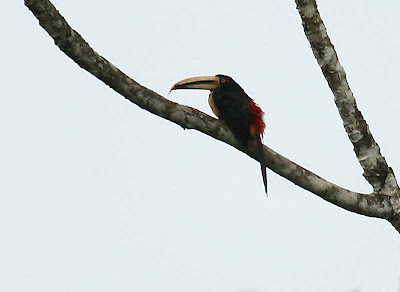
Pale-mandibled Aracari

The Pale-mandibled Aracari is a species of bird in the Ramphastidae family. It is found in Ecuador and Peru.

Full Story >>

Fiery-billed Aracari

Like other toucans, the Fiery-billed Aracari is brightly marked and has a large bill. The adult is typically 43 cm long and weighs 250 g.

The sexes are alike in appearance, with a black head and chest and dark olive green upperparts, apart from a red rump and upper tail. There is reddish collar on the rear neck. The underparts are bright yellow, with a round black spot in the centre of the breast and a red band across the belly. The thighs are chestnut.

The bare facial skin is black, becoming ruddy behind the yellow eye. The upper mandible of the bill is bright orange, the lower mandible is black, and the legs are green.

Juvenile Fiery-billed Aracaris are much duller, with sooty-black head and brownish green upperparts. The red rump and yellow underparts are paler, and the breast spot, belly band and bill pattern are indistinct.

This species is similar to the closely-related Collared Aracari, Pteroglossus torquatus, with which it is sometimes considered conspecific. It differs from Collared in the orange upper mandible, red belly band, and larger dark breast spot.

The call of the Fiery-billed Aracari is a loud, sharp pseek, or keeseek, similar to that of Collared, but more often two-noted.

Behaviour

Small flocks, usually consisting of up to 10 birds, move through the forest with a rapid direct flight. This species is primarily an arboreal fruit-eater, but will also take insects, lizards, bird eggs, and other small prey.

Reproduction

The Fiery-billed Aracari is a common resident breeder in lowland forests and clearings. The two white eggs are laid in an old woodpecker nest, 6-30 m high in a tree. Both sexes incubate the eggs for about 16 days, and the toucan chicks remain in the nest after hatching. They are blind and naked at birth, and have short bills and specialised pads on their heels to protect them from the rough floor of the nest. They are fed by both parents, assisted by up to three other adults, probably from a previous brood, and fledge after about 6 weeks, with feeding by the adults continuing for several weeks after leaving the nest.

The aracaris are unusual for toucans in that they roost socially throughout the year, up to five adults and fledged young of this species sleeping in the same hole with their tails folded over their backs.

Full Story >>

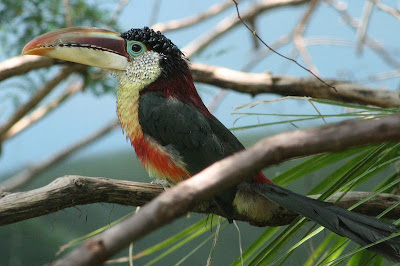
Curl-crested Aracari

The Curl-crested Aracari, also known as the Curly-crested Aracari, is a species of bird in the Ramphastidae family, the Toucans. On account of its relatively long tail and curly crest (the latter only visible up close), it was formerly placed in the monotypic genus Beauharnaisius.

Range and ecology

The Curl-crested Aracari is found in the southwestern section of the Amazon Basin, with the Amazon River being its northern range limit. Near the Amazon River, its range extends east to about the Madeira River, while it in the southern half of its range extends east to around the Xingu River. It is overall rare to uncommon, but regularly seen at several localities, including the Tambopata-Candamo reserve in Peru, the Noel Kempff Mercado National Park in Bolivia, and the Cristalino State Park near Alta Floresta in Brazil.

It is found in Amazonian Peru, Bolivia and Brazil south of the Amazon River. Its natural habitat is tropical moist lowland forests. It is primarily a frugivore, but will also take nestling of birds such as the Yellow-rumped Cacique.

Due to its extensive range, it is considered to be of least concern by BirdLife International and consequently the IUCN.

Full Story >>

Many-banded Aracari Information

The Many-banded Aracari is a species of bird in the Ramphastidae family.

It is found in Brazil, Colombia, Ecuador, Peru, and Venezuela. Its natural habitat is subtropical or tropical moist lowland forests.

Full Story >>

Chestnut-eared Aracari

The Chestnut-eared Aracari is a bird native to central and south-eastern South America. It belongs to the toucan and aracari family.

The range of the Chestnut-eared Aracari is the southern Amazon Basin, especially the southwestern of this region. It is also found in the eastern Andean foothills; a narrowing range extension enters central-southern Colombia by 900 km.

The southern Amazon Basin range narrows in the southeast to only the upstream half-headwaters of the north-flowing Amazon River tributaries. This range continues southeastwards into the central and southern Cerrado and ends in the Paraná River region in eastern Paraguay, southeastern Brazil and the extreme northeast of Argentina.

Ischnoceran lice found on the Chestnut-eared Aracari were first described as Austrophilopterus cancellosus castanotus. But these parasites are actually indistinguishable from those on most other Pteroglossus, and today united with them in Austrophilopterus flavirostris.
Full Story >>

Pets for sale - Latest Ads